Heating optimization in buildings is fundamentally about balancing three key factors: indoor comfort, energy consumption, and operational efficiency. With rising energy costs and stricter sustainability requirements, interest in smarter heating system controls has grown rapidly.
But what does heating optimization actually entail? And what concrete results can one expect?
In this article, we’ll explore three key areas where modern, model-based heating control often makes the biggest difference: a more stable indoor climate, reduced energy consumption, and improved operational support.
A consistent and predictable indoor climate is a key factor in both comfort and customer satisfaction. In many buildings, the heating system is still controlled using relatively simple control principles, which often leads to temperature fluctuations throughout the day or across the seasons.
An alternative to this is model-based, proactive control. This type of control uses mathematical models to describe how a building responds to various external factors, such as outdoor temperature, solar radiation, and wind. By anticipating changes, the system can adjust the heat supply in advance, rather than reacting after the fact.
To evaluate the effectiveness of different control strategies, comparisons are often made with so-called twin properties—buildings with similar characteristics where different types of control are applied. This method makes it possible to isolate the effect of the control itself and minimize the influence of external factors.
Such comparisons often reveal clear differences in temperature fluctuations. Buildings with optimized control systems generally exhibit smaller fluctuations, both over the course of a day and over longer periods.
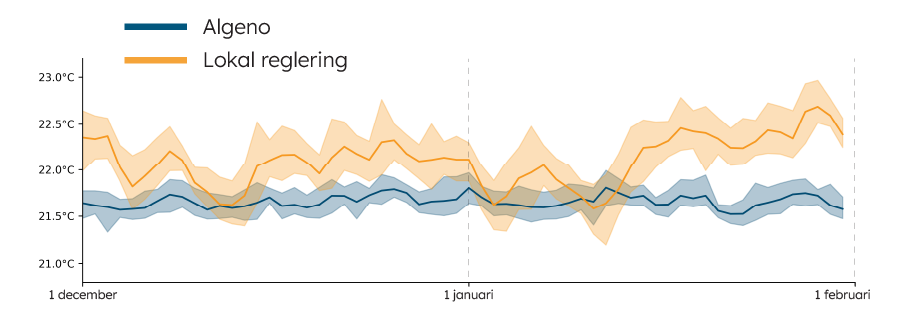
Another way to analyze this is by studying the distribution of indoor temperatures over time, for example using histograms. A narrower distribution indicates a more consistent indoor climate, which in turn reduces the risk of both cold and overheated apartments.

An important consequence of this is that the average temperature in a building can often be lowered without compromising comfort. In practice, in some cases it has been possible to lower the average temperature by about 0.4–0.6 °C compared to similar buildings, without an increase in the number of complaints.
Heating accounts for a significant portion of energy consumption in many buildings, making energy efficiency a key concern for property owners.
Model-based heating control aims to achieve the desired indoor climate while minimizing energy consumption. One approach involves using predictive algorithms that take into account both the building’s characteristics and upcoming weather conditions.
In this way, the system can avoid unnecessary heating, for example by reducing the output in advance when solar radiation is expected.
In practice, the extent of the savings varies depending on factors such as the building’s technical condition, previous optimization levels, and operational strategy. At the same time, experience with various types of properties shows that predictive control often leads to a significant reduction in energy consumption.
In addition to lower costs, this also reduces the environmental impact, making heating optimization a key component of energy efficiency efforts.
Optimizing heating systems is not just about automated control; it’s also about providing the operations team with the right conditions to work efficiently.
As buildings become more connected, the opportunities to collect and visualize data in real time are increasing. A well-designed operations management system can provide a consolidated overview of multiple properties and make it easier to monitor temperatures, system status, and anomalies.
This enables a more proactive approach, where issues can be identified and resolved before they lead to comfort problems or unnecessary energy consumption. At the same time, the need for manual checks can be reduced, freeing up time for more strategic work and allowing operations technicians to focus on the properties that need it most.
Web-based platforms are a great tool for this purpose, as operations staff can analyze data, compare properties, and track the impact of various measures over time. Learn more about Algeno’s web-based platform Algeno Monitor here.
Ultimately, heating optimization is about using data and control systems in a more intelligent way. By combining model-based control with clear monitoring, property owners can achieve several benefits at once:
Although results vary from property to property, experience shows that the potential is often significant—especially in buildings where control systems have previously been limited.
Please follow us on LinkedIn and subscribe to our newsletter for product updates, events and other things happening at Algeno.


Algeno is an AI-powered service for heating optimization and energy efficiency of buildings that delivers a stable indoor climate and lower heating costs in apartment buildings, offices and public properties.

+46 702 63 26 11

info@algeno.se

Läraregatan 3, 411 33 Göteborg, Sweden
Algeno © 2026 All rights reserved