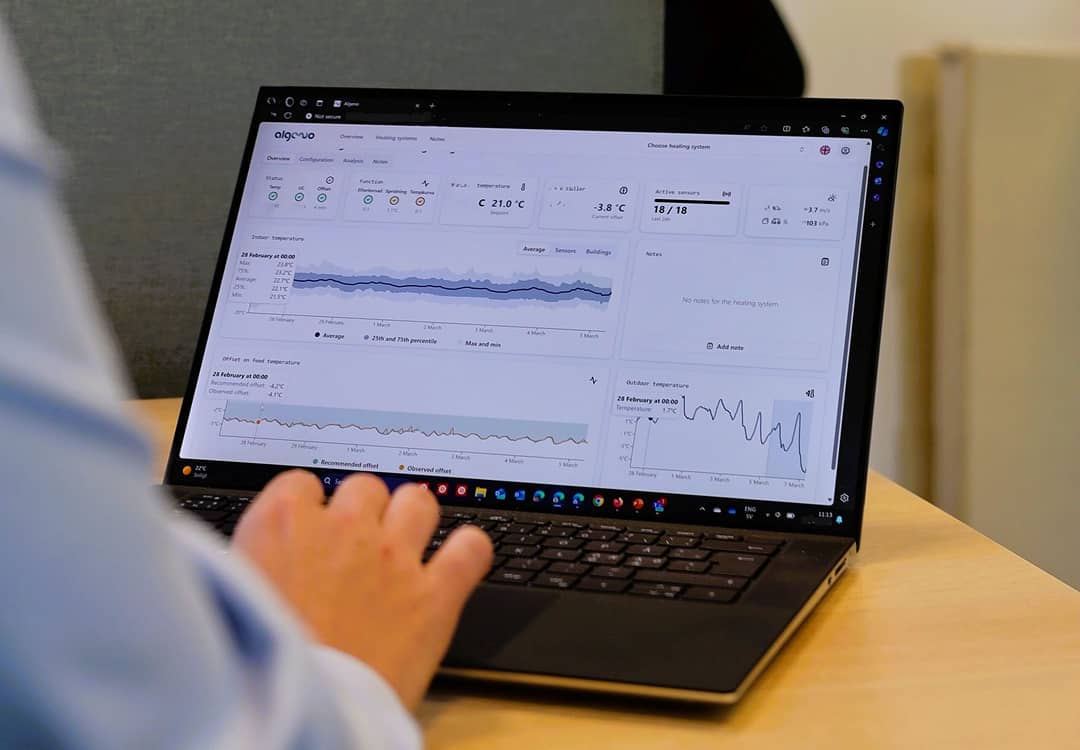
Algeno currently manages the heating systems in over 40,000 apartments in Sweden. Our model-based control system helps property owners reduce their properties’ carbon footprint through smarter optimization of heating systems.
Model Predictive Control (MPC) is an advanced method for optimizing heating systems in buildings. It is based on a dynamic model that continuously learns and adapts to the building’s specific characteristics and behavior. This model is created and updated automatically by analyzing data from the building and its systems, eliminating the need for manual entry of building information.
The model is designed to reflect how the building responds to various factors, both internal (e.g., heating, ventilation) and external (e.g., outdoor temperature, solar radiation, wind). Once the model has been sufficiently trained, it functions as a digital twin of the building, enabling accurate simulations and predictions.
In the next step, the model is used to control the heating system in an optimal manner, based on predetermined goals and conditions. The property owner defines the goals to be achieved—such as minimizing energy consumption or power draw—as well as the conditions that must be met, such as the desired indoor temperature.
The control system also takes into account weather forecasts for the next 48 hours so it can act proactively and adjust the heating in advance. The result is a more consistent indoor temperature, reduced energy consumption, and lower costs.

Traditional heating system control is often based on a preset temperature curve that relates the outdoor temperature to the supply water temperature in the radiator system. Essentially, this means that a higher supply water temperature is used when outdoor temperatures are colder, and vice versa when outdoor temperatures are warmer. No information or feedback regarding the indoor climate is used in the control system; instead, the system relies on the temperature curve having been set correctly initially, with manual adjustments made in response to feedback from tenants or when an operations technician realizes that the indoor climate is not as expected.
A more advanced form of traditional control is room-feedback control, which uses data from indoor sensors to adjust the supply water temperature. Simply put, the supply water temperature is increased if the indoor temperature is too low compared to the target temperature, and vice versa when the indoor temperature is too high.
Although this is a step in the right direction, it still has significant limitations compared to model-based regulation, with the two main features that are missing being:
Feedback-based control is a purely reactive form of control that responds only to changes in the building. Model-based control is essentially a proactive form of control that utilizes both historical data and future forecasts.
Since we have access to a model of how the building behaves and its characteristics, we can simulate how the building will behave in the coming hours or days based on weather forecasts and how the heating system is controlled. By using forecasts for various weather factors, one can, for example, prepare for a rapidly dropping outdoor temperature expected tomorrow or lower the supply water temperature now, since one knows that solar radiation will increase significantly in a few hours.
The result is a much more consistent indoor climate that is not as heavily influenced by changes in external factors.
Feedback control aims to maintain a specific average indoor temperature at all times, but the economic aspect of the control is never taken into account. In model-based control, the optimization process has a clear economic objective: to minimize heating costs while adhering to the specified conditions. This means that control is always aimed at minimizing costs, which allows both energy and power costs to be included in the optimization. It also makes it possible to optimize control based on spot prices for electricity in cases where heat pumps are used as the primary energy source.
The result is minimized heating costs while meeting the specified requirements.

One of the most challenging aspects of Algeno’s system is learning the behaviors and characteristics of different properties. For each individual property, a unique AI model is created that continuously learns how the buildings respond to changes in both internal and external factors. The models are entirely data-driven, meaning they rely solely on data from the properties and their systems. No manual steps or building information are required; instead, the AI models learn directly from how the property actually behaves.
It is also important to continuously update the models, as buildings behave differently depending on the season, and changes are constantly occurring in the building and its behavior.
For more information, please contact us at info@algeno.se we’d be happy to explain in detail how our technology works.

Please follow us on LinkedIn and subscribe to our newsletter for product updates, events and other things happening at Algeno.


Algeno is an AI-powered service for heating optimization and energy efficiency of buildings that delivers a stable indoor climate and lower heating costs in apartment buildings, offices and public properties.

+46 702 63 26 11

info@algeno.se

Läraregatan 3, 411 33 Göteborg, Sweden
Algeno © 2026 All rights reserved